 alt="AI-Defined Vehicles Explained: How AI is Transforming the Future of Automotive">

Key Takeaways
- AI-Defined Vehicles use artificial intelligence as the core decision-making system instead of relying only on predefined software rules.
- Unlike Software-Defined Vehicles, AI-Defined Vehicles can learn, adapt and improve their performance over time.
- Foundation AI models help vehicles understand complex driving situations and make more intelligent real-time decisions.
- AI-Defined Vehicles combine technologies such as computer vision, sensor fusion, LiDAR, radar, edge AI, cloud computing and over-the-air (OTA) updates.
- Artificial intelligence enhances vehicle safety through real-time hazard detection, predictive maintenance, driver monitoring and smarter driving assistance.
- AI-Defined Vehicles deliver a more personalized driving experience by learning driver preferences and optimizing routes, comfort and in-car interactions.
- Industries including passenger transportation, logistics, public transit, agriculture, construction and emergency services are already adopting AI-powered vehicle technologies.
- Challenges such as cybersecurity, data privacy, regulations, computing costs and public trust must be addressed before widespread adoption.
- Future AI-Defined Vehicles are expected to include AI agents, Vehicle-to-Everything (V2X) communication, end-to-end autonomous driving and deeper integration with smart cities.
- AI-Defined Vehicles represent the next major evolution of the automotive industry and are expected to become the foundation of future intelligent mobility.
Introduction: The Automotive Industry is Entering the AI Era
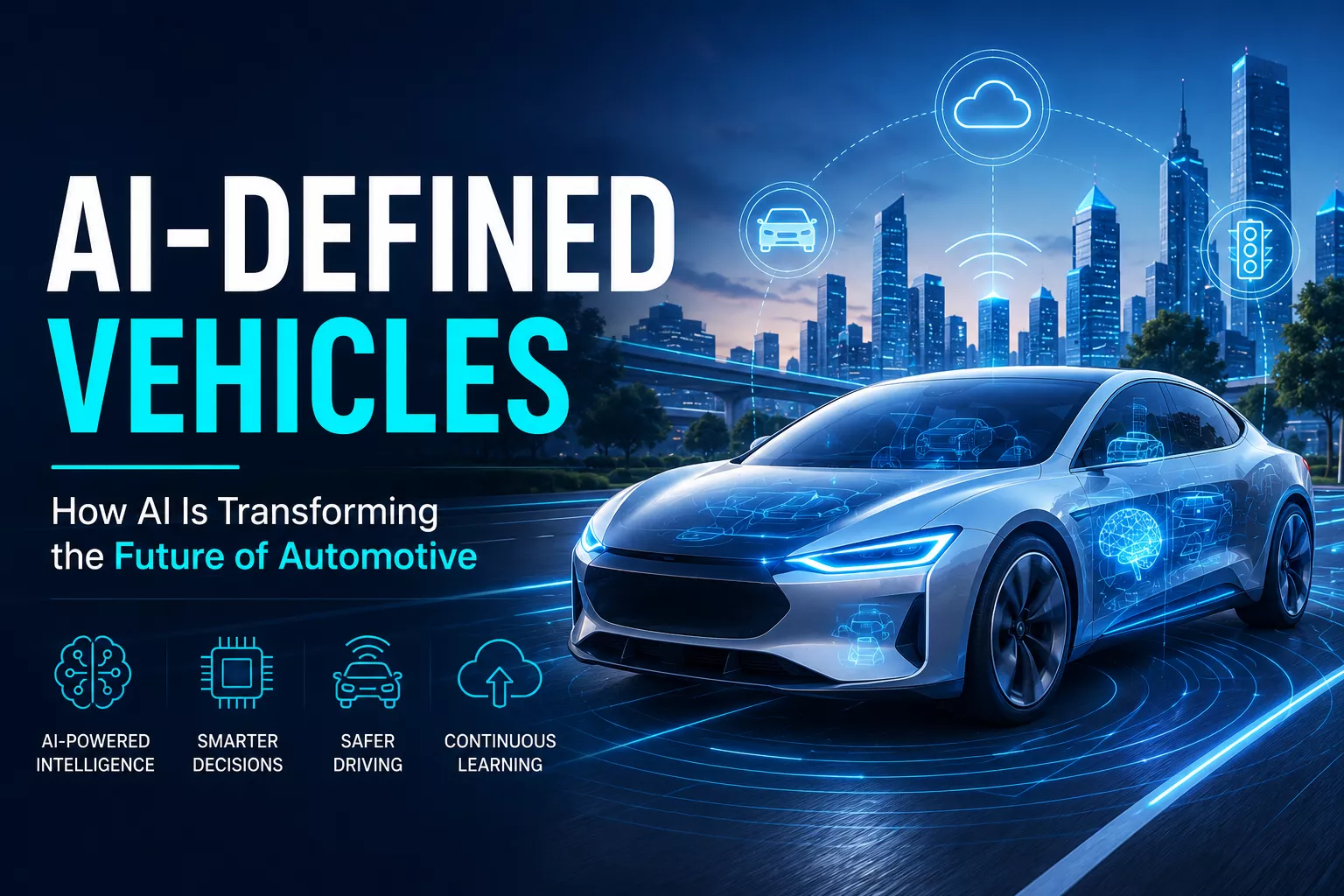
The automotive industry is entering a new era where artificial intelligence is becoming the driving force behind modern vehicles. After years of innovation driven by electrification, connectivity and Software-Defined Vehicles (SDVs), the industry is now taking its next major leap toward AI-Defined Vehicles (AIDVs). This shift is redefining how vehicles perceive their surroundings, make decisions and continuously improve over time.
Unlike traditional vehicles, where software primarily enables digital features and over-the-air (OTA) updates, AI-Defined Vehicles place artificial intelligence at the core of the vehicle architecture. Instead of following predefined rules alone, these vehicles can analyze vast amounts of real-time data, adapt to changing driving conditions, personalize the in-car experience and support increasingly intelligent driving decisions. Simply put, AI is evolving from a software feature into the brain of the vehicle.
Why is this happening now? The answer lies in the rapid advancement of foundation models, high-performance computing and AI-driven automotive platforms. As vehicles generate enormous volumes of data through cameras, radar, LiDAR and connected sensors, conventional rule-based systems are reaching their limits. Automakers are now embracing large AI models that can learn from billions of miles of driving data, enabling vehicles to handle complex real-world scenarios more efficiently and continuously improve their performance.
This transformation is driving unprecedented investment across the automotive industry. Global automakers and technology leaders including NVIDIA, Mercedes-Benz, Volvo, Hyundai, Rivian and BYD are developing AI-native vehicle platforms built on centralized computing, intelligent software architectures and end-to-end AI capabilities. Their goal extends beyond adding smarter features; they are creating vehicles that can learn, adapt and evolve throughout their lifecycle.
In this guide, you'll learn what AI-Defined Vehicles are, how they differ from Software-Defined Vehicles, the technologies powering this transformation, the role of foundation models in autonomous driving and why AI is set to redefine the future of the automotive industry.
What is an AI-Defined Vehicle (AIDV)?
An AI-Defined Vehicle (AIDV) is a next-generation vehicle that uses artificial intelligence as its core decision-making system, enabling it to continuously learn, adapt and optimize its behavior based on real-world data. Unlike traditional vehicles or even Software-Defined Vehicles (SDVs) where software follows predefined rules and logic, AI-Defined Vehicles rely on advanced AI models to interpret complex driving environments, make intelligent decisions and improve performance over time.
In simple terms, a Software-Defined Vehicle is powered by software, while an AI-Defined Vehicle is powered by intelligence.
AI is increasingly being described as the decision engine of modern vehicles. Instead of relying solely on thousands of manually programmed rules, AI can evaluate multiple variables simultaneously, understand context and make decisions that are more adaptive and human-like. As AI models continue to learn from millions or even billions of miles of driving data, they become better at handling everyday traffic conditions as well as rare and unpredictable scenarios.
It's also important to understand that an AI-Defined Vehicle is not simply a car with AI-powered features. Instead of treating AI as one component among many, it places AI at the center of the vehicle architecture. The same intelligence layer can support perception, decision-making, driver assistance, energy management, predictive maintenance, infotainment and autonomous driving capabilities, allowing different vehicle systems to work together more intelligently. As the automotive industry moves toward end-to-end autonomous driving, AI-Defined Vehicles are expected to become the foundation of future mobility.
Why the Automotive Industry Is Moving Beyond Software-Defined Vehicles
The automotive industry has evolved significantly over the last few decades. Every generation of vehicles has introduced new technologies that improved safety, performance and the overall driving experience. Today, the industry is entering its next major phase AI-Defined Vehicles (AIDVs).
This evolution didn't happen overnight. It has progressed through four major stages:
- Traditional Vehicles
- Connected Vehicles
- Software-Defined Vehicles (SDVs)
- AI-Defined Vehicles (AIDVs)
Traditional Vehicles: Built Around Hardware
For decades, vehicles were primarily hardware-driven machines. Almost every function from braking and steering to climate control and engine management as controlled by dedicated mechanical components and electronic control units (ECUs). Once a vehicle left the factory, its capabilities remained largely unchanged throughout its lifespan.
Adding new features often required replacing physical components or installing entirely new hardware, making upgrades expensive and time-consuming. While these vehicles were reliable, they lacked the flexibility to adapt to changing customer expectations or emerging technologies.
In simple terms, traditional vehicles were designed to perform a fixed set of functions rather than continuously evolve after purchase.
Connected Vehicles: Bringing Cars Online
The next major milestone was the rise of Connected Vehicles, which introduced internet connectivity and cloud-based communication to the automotive industry.
Connected vehicles could exchange information with manufacturers, cloud platforms, mobile applications and even other connected devices. This enabled features such as GPS navigation, real-time traffic updates, remote diagnostics, vehicle tracking, smartphone integration and emergency assistance services. However, despite being connected, most vehicle functions still depended on traditional software and hardware architectures, limiting their ability to adapt intelligently to real-world situations.
Software-Defined Vehicles (SDVs): The Era of Software Innovation
As customer expectations grew, automakers shifted from hardware-centric development to Software-Defined Vehicles (SDVs).
Instead of relying on hardware upgrades, manufacturers could now improve vehicle functionality through software. One of the biggest advantages of SDVs is the ability to deliver over-the-air (OTA) updates, allowing new features, security patches, bug fixes, and performance improvements to be installed remotely without requiring a visit to the dealership. Software-Defined Vehicles also introduced advanced infotainment systems, digital cockpits, connected services and enhanced Advanced Driver Assistance Systems (ADAS).
However, Software-Defined Vehicles still operate largely on predefined software rules. Engineers must manually program the logic for how a vehicle should react in different situations.
AI-Defined Vehicles (AIDVs): Vehicles That Learn and Adapt
The next evolution is the AI-Defined Vehicle (AIDV), where artificial intelligence becomes the vehicle's central intelligence system rather than just another software feature. Instead of relying primarily on manually programmed rules, AI-Defined Vehicles use foundation models, machine learning, computer vision and real-time data processing to understand their surroundings, make intelligent decisions and continuously improve over time.
Every second, these vehicles process massive amounts of data from cameras, radar, LiDAR, GPS, driver monitoring systems and connected services. AI analyzes this information to understand road conditions, predict potential hazards, optimize routes, improve energy efficiency, personalize the driving experience and support increasingly advanced autonomous driving capabilities.
AI-Defined Vehicles vs. Software-Defined Vehicles: What's the Difference?
The table below highlights the key differences between these two generations of vehicles:
| Feature | Software-Defined Vehicles (SDVs) | AI-Defined Vehicles (AIDVs) |
| Vehicle Brain | Software controls individual vehicle functions using predefined logic. | AI acts as the central intelligence layer that coordinates the entire vehicle. |
| Decision Making | Decisions are based on fixed rules programmed by engineers. | Decisions are made using AI models that analyze real-time data and context. |
| Learning | Does not learn from experience. Improvements come through software updates. | Continuously learns from data and improves performance over time. |
| Software Updates | Receives OTA updates for new features, bug fixes and security patches. | Receives OTA updates while also improving AI models and decision-making capabilities. |
| Driver Personalization | Offers basic customization such as seat positions and infotainment settings. | Learns driver preferences and automatically personalizes routes, cabin settings, entertainment and driving assistance. |
| Safety | Responds using predefined safety rules and programmed scenarios. | Uses AI to predict risks, detect unusual situations and adapt safety responses in real time. |
| Navigation | Relies on GPS and traffic information to suggest routes. | Continuously optimizes routes by considering traffic, weather, driver behavior, road conditions, charging stations and other real-time data. |
| Advanced Driver Assistance Systems (ADAS) | Supports features such as lane keeping, adaptive cruise control and emergency braking based on predefined logic. | Uses AI to continuously improve perception, planning and driver assistance by learning from real-world driving data. |
| Autonomous Driving | Supports limited autonomous features using rule-based systems. | Forms the foundation for next-generation autonomous driving powered by foundation models and AI reasoning. |
| Predictive Maintenance | Alerts drivers based on predefined service schedules and diagnostic rules. | Predicts potential component failures by continuously analyzing vehicle health and sensor data. |
| Energy Optimization | Optimizes energy usage using predefined software algorithms. | Uses AI to dynamically optimize battery performance, charging strategy, regenerative braking and energy consumption. |
| User Experience | Provides connected services and digital features through software. | Delivers highly personalized, conversational and context-aware experiences powered by AI assistants. |
| Future Readiness | Designed primarily for software upgrades. | Designed to continuously evolve through AI learning, larger foundation models and increasingly intelligent capabilities. |
How AI-Defined Vehicles Work: Step-by-Step Explained
An AI-Defined Vehicle (AIDV) doesn't make decisions instantly. Instead, it follows a continuous process that allows it to understand its surroundings, analyze information, make intelligent decisions and improve over time. Think of it like the human brain. Before you make a decision while driving, your eyes observe the road, your brain processes the information, you decide what to do and your hands and feet control the vehicle.
This vehicle follows a very similar process but instead of human senses and a human brain, it uses sensors, artificial intelligence and powerful computing systems.
From collecting data to making driving decisions, every action passes through seven connected stages, as shown below:

Step 1: Sensors Collect Information
Just as humans use their eyes and ears to understand their surroundings, AI-Defined Vehicles use multiple sensors to continuously observe the world around them.
These include:
- Cameras
- LiDAR
- Radar
- Ultrasonic sensors
- GPS
- Inertial sensors
- Driver monitoring cameras
Together, these sensors collect enormous amounts of information every second, including nearby vehicles, pedestrians, traffic signs, road markings, weather conditions, obstacles and the driver's behavior. However, collecting data is only the first step. The vehicle must also understand what all this information means.
Step 2: Data Fusion Combines Everything Together
Each sensor sees the world differently.
For example, cameras capture colors and traffic signs, radar measures the speed of nearby vehicles, while LiDAR creates an accurate 3D map of the surrounding environment. Instead of treating these as separate sources, the vehicle combines them into one complete picture using a process called data fusion. This allows the AI system to build a more accurate understanding of its surroundings than any single sensor could provide on its own.
Think of data fusion as assembling pieces of a puzzle. Individually, each piece provides only partial information. Together, they create a complete picture of the road.
Step 3: Foundation AI Models Understand the Situation
Once all the data has been combined, it is processed by a Foundation AI Model.
A foundation model is a large AI model trained using billions of miles of driving data collected from different roads, weather conditions, traffic environments and driving situations. Instead of relying only on manually programmed rules, the model learns patterns from real-world driving experiences.
For example, it can recognize:
- A pedestrian about to cross the road
- An emergency vehicle approaching from behind
- A cyclist changing lanes
- A temporary construction zone
- Slippery road conditions after rain
Step 4: The Reasoning Engine Evaluates the Best Action
Understanding the environment is only half the job. The vehicle must also decide what should happen next. This is where the Reasoning Engine comes into play.
It evaluates the current situation by considering multiple factors at the same time, such as:
- Vehicle speed
- Traffic flow
- Road conditions
- Weather
- Nearby pedestrians
- Driver intentions
- Safety risks
This ability to understand context is one of the biggest differences between AI-Defined Vehicles and traditional software-driven vehicles.
Step 5: The Decision Engine Takes Action
After the reasoning process is complete, the Decision Engine converts the AI's conclusions into real driving actions.
Depending on the situation, it may:
- Apply the brakes
- Accelerate smoothly
- Change lanes
- Adjust steering
- Recommend an alternative route
- Warn the driver
- Activate emergency safety systems
These decisions happen within milliseconds, allowing the vehicle to respond much faster than a human driver in many situations.
Step 6: Vehicle Controls Execute the Commands
Once a decision has been made, the vehicle's control systems carry it out.
These systems communicate with components responsible for:
- Steering
- Braking
- Acceleration
- Suspension
- Battery management
- Climate control
- Lighting
- Infotainment
Unlike older vehicles, where individual systems often worked independently, AI-Defined Vehicles use centralized computing to coordinate multiple systems simultaneously. This allows the vehicle to react more smoothly and efficiently while improving overall safety and driving performance.
Step 7: Continuous Learning Makes the Vehicle Smarter
The process doesn't stop after the vehicle completes an action. One of the defining characteristics of an AI-Defined Vehicle is its ability to continuously improve. Every trip generates valuable driving data that helps manufacturers refine AI models, improve safety and develop new capabilities.
This continuous learning approach is one of the main reasons AI-Defined Vehicles are considered the future of intelligent mobility.
Technologies Powering AI-Defined Vehicles
Behind this entire process are several advanced technologies working together.

Edge AI
Many driving decisions must be made instantly. Waiting for information to travel to the cloud and back would take too long.
Edge AI allows the vehicle to process data directly inside the car, enabling real-time responses for steering, braking, obstacle detection and driver assistance.
Cloud AI
While immediate decisions happen inside the vehicle, the cloud supports large-scale AI training, fleet-wide learning, software updates and long-term performance improvements.
Cloud AI helps manufacturers continuously improve AI models using driving data collected from thousands or even millions of vehicles.
Vehicle Operating System (Vehicle OS)
A Vehicle Operating System (Vehicle OS) acts as the software platform that connects all hardware, applications, sensors and AI systems.
Just as Android or iOS manages a smartphone, the Vehicle OS manages communication between different vehicle components while supporting AI-powered features.
Centralized Computing
AI-Defined Vehicles are increasingly replacing these with centralized computing platforms, where powerful processors coordinate multiple vehicle systems from a single computing architecture.
This simplifies software development while enabling faster and more intelligent decision-making.
AI Inference
Once an AI model has been trained, it must apply what it has learned to real-world situations. This process is called AI inference.
Every time an AI-Defined Vehicle recognizes a pedestrian, predicts a collision, identifies a traffic sign, or recommends a safer route, it is performing AI inference in real time.
Digital Twins
A digital twin is a virtual copy of a physical vehicle.
Manufacturers use digital twins to simulate millions of driving scenarios, test software updates, validate AI models and identify potential issues before deploying new features to real vehicles. This helps improve safety while reducing development time.
High-Performance Computing
Processing information from multiple sensors while running advanced AI models requires enormous computing power. Modern AI-Defined Vehicles use high-performance computing (HPC) platforms capable of processing trillions of operations every second.
In simple terms, an AI-Defined Vehicle works like a highly intelligent co-driver. It continuously observes its surroundings, understands what is happening, decides on the safest action, controls the vehicle and keeps improving through AI. This combination of sensors, foundation models, real-time reasoning and continuous learning is what makes AI-Defined Vehicles fundamentally different from previous generations of automobiles.
Foundation Models Are Becoming the Brain of Autonomous Driving
For many years, autonomous vehicles relied on thousands of manually programmed rules to make driving decisions. Engineers had to teach the vehicle how to respond to specific situations, such as stopping at a red light, avoiding obstacles or changing lanes safely. While this approach worked for predictable scenarios, it struggled when vehicles encountered unfamiliar or complex situations on real roads.
This is where foundation models are changing the future of autonomous driving.
Instead of depending on countless handcrafted rules, foundation models learn from massive amounts of driving data. They help vehicles understand their surroundings, recognize patterns and make better decisions in situations they may have never encountered before.
A foundation model is a large artificial intelligence model trained on enormous amounts of data before it is deployed in real-world applications.
Learn more about NVIDIA's Cosmos world foundation models for autonomous vehicles:
In the automotive industry, these models are trained using billions of miles of driving data collected from different road types, weather conditions, traffic patterns and driving environments. Rather than memorizing individual scenarios, foundation models learn general driving behavior, allowing them to understand new situations and make intelligent decisions. Think of it like teaching someone how to drive, instead of giving them a rulebook for every possible situation they might face.
Why Autonomous Driving Needs Foundation Models
A vehicle may encounter road construction, unexpected pedestrian movements, unusual traffic behavior, or severe weather conditions that were never specifically programmed into traditional driving software.
Foundation models help solve this challenge by learning from diverse driving experiences instead of relying only on predefined rules. As a result, autonomous vehicles become more adaptable, safer and better prepared to handle situations that are difficult to predict.
Foundation Models vs. Traditional Rule-Based Systems
| Traditional Rule-Based Systems | AI Foundation Models |
| Depend on manually written rules | Learn from massive driving datasets |
| Handle predefined scenarios | Adapt to unfamiliar situations |
| Require engineers to add new rules | Improve through continuous AI training |
| Difficult to scale for every driving condition | Generalize across different roads and environments |
| Limited flexibility | More intelligent and context-aware decision-making |
Benefits of Foundation Models in Autonomous Driving
Foundation models are transforming autonomous driving in several important ways.
- Better generalization by applying learned knowledge to new driving situations instead of depending on fixed rules.
- Improved handling of rare edge cases, such as unusual road events or unexpected driver behavior.
- Continuous learning, allowing AI models to improve as more driving data becomes available.
- Reduced rule-based programming, which lowers development complexity and speeds up innovation.
- More human-like driving, with smoother, context-aware decisions instead of rigid responses.
- Faster deployment across vehicle models, since the same AI foundation can support multiple vehicle platforms with additional fine-tuning.
The Industry is Moving Toward End-to-End AI Driving
The automotive industry is now moving beyond traditional software pipelines toward end-to-end autonomous driving, where a single AI model can understand the environment and make driving decisions with far less manually engineered logic.
Leading companies such as NVIDIA are driving this transition by emphasizing a new development approach built on larger AI models, more driving data and high-performance computing instead of writing increasingly complex rule-based code. At the same time, safety remains a top priority. Before these AI models are deployed on public roads, they are extensively tested through large-scale simulations, digital twins, validation frameworks and real-world driving evaluations to ensure they perform reliably in a wide range of driving conditions.
As foundation models continue to improve, they are expected to become the core intelligence behind the next generation of AI-Defined Vehicles, enabling safer, smarter and more capable autonomous driving systems.
Key Features of AI-Defined Vehicles
AI-Defined Vehicles combine artificial intelligence, real-time data and advanced computing to deliver a safer, smarter and more personalized driving experience. Here are the key features that make these next-generation vehicles different from traditional and software-defined vehicles.
AI-Powered Driving Decisions
- Continuously analyzes road conditions, traffic, weather and nearby vehicles.
- Makes intelligent driving decisions in real time.
- Improves safety, comfort and overall driving efficiency.
Personalized Driving Experience
- Learns the driver's preferences over time.
- Automatically adjusts seat position, mirrors, climate settings and driving modes.
- Creates a customized driving experience for every user.
AI Cockpit Assistants
- Acts as an intelligent in-car assistant.
- Answers questions, provides reminders and explains vehicle alerts.
- Controls vehicle functions using AI-powered assistance.
Natural Language Interaction
- Understands everyday voice commands without requiring specific phrases.
- Allows drivers to control navigation, music, calls and climate using natural conversation.
- Reduces distractions while driving.
Intelligent Navigation
- Uses real-time traffic, weather and road information.
- Suggests faster, safer and more efficient routes.
- Recommends nearby charging stations or fuel stops when needed.
Adaptive Suspension
- Adjusts suspension settings based on road conditions.
- Improves ride comfort and vehicle stability.
- Enhances handling on different terrains.
Predictive Maintenance
- Continuously monitors the health of vehicle components.
- Detects potential issues before they become major failures.
- Helps reduce maintenance costs and unexpected breakdowns.
Energy Optimization
- Optimizes power usage during driving.
- Improves fuel efficiency and electric vehicle range.
- Reduces unnecessary energy consumption.
Smart Battery Management
- Monitors battery temperature, charging cycles and power usage.
- Maximizes battery performance and lifespan.
- Improves charging efficiency for electric vehicles.
Driver Monitoring
- Detects signs of driver fatigue or distraction.
- Provides alerts when driver attention decreases.
- Supports safer driving through continuous monitoring.
Real-Time Hazard Detection
- Identifies pedestrians, cyclists, vehicles and road obstacles.
- Detects potential hazards within milliseconds.
- Helps prevent accidents through faster AI-assisted responses.
Autonomous Parking
- Automatically identifies suitable parking spaces.
- Controls steering, braking and acceleration during parking.
- Makes parking easier in crowded or tight spaces.
Fleet Intelligence
- Enables connected vehicles to share traffic and road information.
- Improves fleet efficiency through shared learning.
- Supports smarter route planning and vehicle management.
Continuous Software Improvement
- Receives over-the-air (OTA) software updates.
- Adds new AI capabilities and performance improvements after purchase.
- Keeps the vehicle up to date without visiting a service center.
The Business and Consumer Benefits of AI-Defined Vehicles
AI-Defined Vehicles offer advantages not only for drivers but also for automakers and fleet operators. By combining artificial intelligence with connected technologies, these vehicles improve safety, reduce costs, increase efficiency and deliver a better driving experience for everyone involved.
Benefits for Drivers
AI makes driving safer, smarter and more convenient by assisting drivers before, during and after every journey.
Enhanced Safety
- Detects potential hazards in real time.
- Assists with collision avoidance and emergency braking.
- Monitors driver fatigue and distraction to help prevent accidents.
Greater Comfort
- Automatically adjusts seat position, climate control and suspension.
- Delivers a smoother and more enjoyable driving experience.
- Reduces driver stress, especially during long journeys.
Improved Convenience
- Supports natural voice commands for hands-free control.
- Provides intelligent navigation with real-time traffic updates.
- Simplifies parking with AI-assisted or autonomous parking features.
Personalized Experience
- Learns individual driving habits and preferences.
- Saves personalized settings for different drivers.
- Continuously improves the driving experience through AI learning and software updates.
Benefits for Automakers
AI-Defined Vehicles enable manufacturers to innovate faster while creating new business opportunities beyond selling the vehicle.
Reduced Development Costs
- Reuses AI models across multiple vehicle platforms.
- Minimizes the need for manually programming thousands of driving rules.
- Speeds up software development and testing.
Faster Feature Rollout
- Introduces new AI features through software instead of hardware changes.
- Responds more quickly to customer needs and market trends.
- Shortens the time required to launch new capabilities.
Recurring Revenue Opportunities
- Offers premium AI features through subscriptions or software upgrades.
- Creates new revenue streams after the vehicle is sold.
- Supports long-term customer engagement.
Over-the-Air (OTA) Updates
- Delivers software improvements remotely without requiring a service visit.
- Fixes bugs, improves security and adds new features automatically.
- Keeps vehicles updated throughout their lifecycle.
Benefits for Fleet Operators
For businesses managing commercial fleets, AI improves operational efficiency while reducing costs and vehicle downtime.
Predictive Maintenance
- Detects maintenance issues before they become major failures.
- Schedules servicing based on vehicle condition rather than fixed intervals.
- Reduces unexpected repairs and maintenance expenses.
Lower Downtime
- Identifies potential problems early to avoid breakdowns.
- Keeps vehicles on the road for longer periods.
- Improves fleet availability and operational reliability.
Better Operational Efficiency
- Optimizes routes using real-time traffic and road data.
- Improves fuel efficiency or electric vehicle range through AI-powered energy management.
- Helps fleet managers make better decisions using vehicle performance insights.
Real-World Applications of AI-Defined Vehicles Across Industries
AI-Defined Vehicles are no longer a concept for the future. Many automotive companies and technology providers are already using artificial intelligence to make vehicles safer, smarter and more efficient. While passenger cars receive the most attention, AI-defined technology is also transforming commercial transportation, logistics, agriculture, construction and emergency services.
Here are some of the most important real-world applications of AI-Defined Vehicles.
 Passenger Cars
Modern passenger vehicles are increasingly using AI to improve the driving experience. AI helps drivers by recognizing road conditions, assisting with parking, monitoring driver attention, optimizing navigation and personalizing vehicle settings. As AI models continue to improve, passenger cars will become more intelligent through regular over-the-air (OTA) software updates, allowing new features to be added even after the vehicle has been purchased.
Robotaxis
Robotaxis are self-driving vehicles designed to transport passengers without a human driver. AI continuously analyzes data from cameras, radar, LiDAR,and other sensors to understand the surrounding environment, identify obstacles and make safe driving decisions. AI-defined architecture allows robotaxis to learn from millions of driving scenarios, improving their performance over time.
Commercial Trucks
Long-distance trucking involves complex driving conditions, changing weather and heavy traffic. AI helps commercial trucks optimize routes, monitor vehicle health, reduce fuel consumption and support advanced driver assistance features. Fleet operators can also use AI to improve delivery schedules, reduce operating costs and increase road safety.
Public Transportation
Buses and other public transport vehicles can use AI to improve passenger safety and operational efficiency. AI analyzes traffic conditions, predicts delays, recommends better routes and monitors vehicle performance in real time. These capabilities help transportation providers deliver more reliable and efficient services while reducing operational costs.
Logistics and Delivery Fleets
Delivery companies manage thousands of vehicles every day. AI helps optimize delivery routes, reduce fuel consumption, predict maintenance needs and monitor driver behavior. By improving route planning and vehicle utilization, AI enables faster deliveries while lowering transportation costs.
Mining and Construction Vehicles
Mining sites and construction projects often involve dangerous working environments. AI-Defined Vehicles can assist with navigation, obstacle detection, equipment monitoring and semi-autonomous operation in these challenging conditions. This improves worker safety, reduces equipment downtime and increases productivity on job sites.
Smart Agriculture
Modern farming is becoming increasingly data-driven. AI-powered tractors, harvesters and agricultural equipment can analyze field conditions, optimize driving paths, reduce fuel usage and improve precision farming operations. These intelligent systems help farmers increase productivity while using resources more efficiently.
Emergency Vehicles
Emergency response vehicles such as ambulances, fire trucks and police vehicles can use AI to reach destinations faster and operate more safely. AI-powered navigation identifies the quickest routes by analyzing real-time traffic conditions, while advanced driver assistance systems help reduce the risk of accidents during emergency responses.
Why These Applications Matter
AI-Defined Vehicles are expanding far beyond personal transportation. From everyday passenger cars to commercial fleets, agriculture and emergency services, artificial intelligence is helping vehicles make smarter decisions, improve safety, reduce operating costs and increase efficiency. As AI technology continues to advance, its applications are expected to grow across almost every part of the transportation and mobility industry.
Challenges of AI-Defined Vehicles: What Needs to Be Solved?
AI-Defined Vehicles have the potential to make transportation safer, smarter and more efficient. However, like any emerging technology, they also face several challenges before they can be widely adopted. These challenges involve technology, regulations, security and public acceptance.
Understanding these limitations helps explain why the transition to AI-defined mobility is happening gradually rather than overnight.
Safety Validation
AI systems must make accurate driving decisions in millions of different situations. Testing these systems is much more complex than testing traditional vehicle software because every road, weather condition and traffic scenario can be different.
Why it matters: Even a small error in decision-making could affect passenger safety.
Industry response: Automotive companies use large-scale simulations, real-world testing and AI model validation to ensure vehicles perform safely before deployment.
Cybersecurity Risks
AI-Defined Vehicles are connected to cloud platforms, mobile apps, charging networks and other digital services. While this connectivity enables smarter features, it also creates new cybersecurity risks.
Why it matters: Cyberattacks could potentially target vehicle software, connected services, or sensitive data.
Industry response: Manufacturers are strengthening security through encrypted communication, secure software architecture, regular security updates and continuous threat monitoring.
Data Privacy
AI relies on large amounts of data to improve vehicle performance. This may include driving behavior, navigation history, voice commands and vehicle diagnostics.
Why it matters: Drivers want confidence that their personal information is collected responsibly and protected from unauthorized access.
Industry response: Companies are adopting stronger privacy policies, secure data storage, user consent mechanisms and compliance with global data protection regulations.
AI Bias and Decision-Making
AI learns from training data. If that data does not represent enough real-world driving situations, the system may perform better in some conditions than others.
Why it matters: AI should be able to make reliable decisions regardless of location, weather, traffic or road conditions.
Industry response: Developers continuously expand training datasets, improve AI models and test vehicles across diverse environments to reduce bias and improve reliability.
Regulations and Legal Responsibility
Governments around the world are still developing rules for AI-powered vehicles and autonomous driving technologies.
Why it matters: Manufacturers need clear legal standards for testing, deployment, liability and safety certification before AI-defined vehicles can be widely adopted.
Industry response: Automakers, technology companies and regulators are working together to establish common safety standards and regulatory frameworks.
High Computing Costs
Running advanced AI models requires powerful processors, large amounts of memory and specialized AI hardware.
Why it matters: These technologies increase vehicle development costs and can make advanced AI features more expensive for consumers.
Industry response: AI chips are becoming faster, more energy-efficient and more affordable, helping reduce costs over time.
Building Public Trust
Many people are still unsure about allowing AI to make important driving decisions.
Why it matters: Even if the technology is capable, widespread adoption depends on public confidence in its safety and reliability.
Industry response: Companies are improving transparency, demonstrating real-world safety performance and gradually introducing AI features through advanced driver assistance systems before moving toward higher levels of automation.
Infrastructure Readiness
AI-Defined Vehicles perform best when supported by modern transportation infrastructure.
Why it matters: Reliable digital maps, high-speed connectivity, smart traffic systems and electric vehicle charging networks are not yet available everywhere.
Industry response: Governments and private organizations are investing in connected infrastructure, 5G networks, intelligent transportation systems and EV charging stations to support the future of AI-powered mobility.
Looking Ahead
While these challenges are significant, they are not stopping the progress of AI-Defined Vehicles. Automotive manufacturers, AI companies, governments and technology providers are actively working together to overcome these obstacles through better AI models, stronger regulations, improved cybersecurity, advanced computing hardware and extensive real-world testing. As these challenges are addressed, AI-Defined Vehicles are expected to become safer, more reliable and more widely adopted in the years ahead.
The Future of AI-Defined Vehicles: What Comes Next?
The automotive industry is entering a new era where vehicles will no longer rely only on fixed software or predefined driving rules. Instead, they will use artificial intelligence to understand their surroundings, learn from experience and continuously improve over time.
Many of the technologies discussed throughout this guide are already being tested or introduced by leading automotive and technology companies. As AI continues to evolve, AI-Defined Vehicles are expected to become more intelligent, more connected and more capable than today's vehicles.
Here are some of the biggest trends shaping the future of AI-Defined Vehicles.
AI Agents Inside Cars
Future vehicles will include AI agents that act as intelligent assistants rather than simple voice assistants. These AI agents will understand conversations, remember driver preferences and help complete everyday tasks.
For example, instead of asking for a single command, a driver could simply say:
"I'm running late for my meeting."
The AI agent could automatically find the fastest route, notify meeting participants about the delay, reserve a nearby parking space and adjust the cabin temperature before arrival.
As these AI agents become more advanced, they will provide a more natural and personalized driving experience.
End-to-End Autonomous Driving
Today's autonomous driving systems often rely on multiple software modules, each responsible for a specific task such as object detection, lane detection or path planning. The future is moving toward end-to-end AI models that learn the complete driving process using large amounts of driving data.
Instead of following thousands of manually programmed rules, these models can observe, learn and make driving decisions much like an experienced human driver.
This approach simplifies system design while helping vehicles adapt to more complex real-world situations.
Vehicle-to-Everything (V2X) Communication
Future AI-Defined vehicles will not only understand their own surroundings but also communicate with everything around them.
This includes:
- Other vehicles
- Traffic signals
- Road infrastructure
- Charging stations
- Cloud-based traffic systems
By sharing information in real time, vehicles can receive early warnings about accidents, traffic congestion, road construction or dangerous weather conditions before they become visible to the driver.
This connected ecosystem can improve road safety, reduce traffic congestion and make transportation more efficient.
AI, Robotics and Smart Cities
As cities become smarter, AI-Defined Vehicles will become an important part of connected urban transportation.
Future mobility systems may connect:
- Autonomous vehicles
- Delivery robots
- Smart traffic lights
- Intelligent parking systems
- Connected public transportation
- Urban traffic management platforms
Instead of operating independently, these technologies will work together to improve traffic flow, reduce emissions and make cities safer and more efficient.
Continuous AI Learning
One of the biggest advantages of AI-Defined Vehicles is that they can continue improving long after they leave the factory.
Through over-the-air (OTA) software updates and continuous AI model improvements, manufacturers can introduce:
- Better driving performance
- Improved safety features
- More accurate navigation
- Smarter AI assistants
- New vehicle capabilities
This means future vehicles will continue becoming more intelligent throughout their lifecycle instead of remaining unchanged after purchase.
Smarter Electric Vehicles
As electric vehicles become more common, AI will play an even bigger role in improving their performance.
Future AI systems are expected to:
- Predict battery health more accurately.
- Optimize charging schedules.
- Improve energy efficiency.
- Recommend the best charging stations.
- Extend battery lifespan through intelligent power management.
By combining AI with electric mobility, manufacturers can deliver vehicles that are more efficient, reliable and cost-effective.
Foundation Models Will Continue to Evolve
Foundation models are expected to become the intelligence layer behind future AI-Defined Vehicles.
Instead of training separate AI systems for every driving task, a single foundation model will understand the complete driving environment and support multiple functions, including:
- Autonomous driving
- Driver assistance
- Intelligent navigation
- Driver interaction
- Vehicle diagnostics
- Predictive maintenance
As these models continue learning from billions of miles of driving data, they are expected to become more capable, more reliable and better at handling unfamiliar situations.
The Road Ahead
AI-Defined Vehicles represent much more than the next generation of connected cars, they represent a fundamental shift in how vehicles are designed, operated and improved.
Instead of relying on fixed software that changes very little over time, future vehicles will continuously learn, adapt and evolve through artificial intelligence. They will communicate with other vehicles and surrounding infrastructure, receive regular software improvements and provide increasingly personalized and intelligent driving experiences.
Although challenges such as regulations, cybersecurity, infrastructure and public trust still need to be addressed, the direction of the automotive industry is becoming increasingly clear. AI is expected to become the intelligence layer of future mobility, making AI-Defined Vehicles the standard architecture for next-generation transportation.
As AI technology continues to advance, the vehicles of tomorrow will not simply transport people from one place to another, they will understand their environment, assist their occupants and continuously improve throughout their lifetime.
Frequently Asked Questions (FAQs)
1. What is an AI-Defined Vehicle?
It's a vehicle that uses artificial intelligence as its core decision-making system. Instead of relying only on fixed software rules, it continuously analyzes data from sensors, cameras, radar and other systems to understand its surroundings, make intelligent driving decisions and improve over time through software updates and AI learning.
2. How is an AI-Defined Vehicle different from a Software-Defined Vehicle?
A Software-Defined Vehicle (SDV) mainly relies on software to control vehicle functions and receive over-the-air (OTA) updates. An AI-Defined Vehicle goes a step further by using AI models that can learn, adapt and make real-time decisions. In simple terms, software defines vehicle functions, while AI enables the vehicle to think, reason and continuously improve.
3. Are AI-Defined Vehicles fully autonomous?
Not always. AI-Defined Vehicles and autonomous vehicles are related but not the same. An AI-Defined Vehicle can include AI-powered driver assistance, intelligent navigation and personalized features without being fully self-driving. However, AI-defined architecture is expected to play a major role in the future development of autonomous driving.
4. How do foundation models improve autonomous driving?
Foundation models are trained on massive amounts of driving data collected from different environments and road conditions. They help AI understand complex situations, recognize objects more accurately, predict possible outcomes and make better driving decisions. This allows autonomous driving systems to become more adaptable and reliable than traditional rule-based approaches.
5. Are AI-Defined Vehicles Safe?
AI-Defined Vehicles are designed to improve road safety by detecting hazards, monitoring driver attention and supporting faster decision-making. However, like any advanced technology, they require extensive testing and continuous validation before large-scale deployment. Automotive companies continue to improve AI models through simulations, real-world testing and regular software updates.
6. Can existing cars become AI-Defined?
Most existing vehicles cannot become fully AI-defined because they may not have the required computing hardware, sensors or AI architecture. However, some modern vehicles can receive new AI-powered features through over-the-air (OTA) software updates if they are built on a software-defined platform with sufficient processing capabilities.
7. Which companies are developing AI-Defined Vehicles?
Several automotive manufacturers and technology companies are actively developing AI-defined vehicle technologies. These include Tesla, Mercedes-Benz, BMW, Volvo, Hyundai, BYD, NVIDIA, Qualcomm, Mobileye and Waymo. Many companies are combining artificial intelligence, advanced computing platforms and foundation models to build the next generation of intelligent vehicles.
8. What technologies power AI-Defined Vehicles?
AI-Defined Vehicles combine several advanced technologies, including artificial intelligence, machine learning, foundation models, computer vision, sensor fusion, LiDAR, radar, cameras, GPS, cloud computing, edge computing, high-performance AI chips and over-the-air (OTA) software updates. Together, these technologies enable vehicles to understand their environment and make intelligent decisions.
9. What are the biggest challenges of AI-Defined Vehicles?
Some of the biggest challenges include ensuring vehicle safety, protecting against cybersecurity threats, maintaining data privacy, reducing AI bias, complying with evolving regulations, managing high computing costs, building public trust and improving infrastructure to support connected mobility.
10. What is the future of AI-Defined Vehicles?
The future of AI-Defined Vehicles lies in intelligent, continuously learning transportation systems. Future vehicles are expected to include AI agents, end-to-end autonomous driving models, Vehicle-to-Everything (V2X) communication, smarter electric vehicle management and deeper integration with smart cities. As AI technology matures, AI-defined architecture is expected to become the foundation of next-generation mobility.
